
Why most maritime websites fail the four-second credibility test
Four seconds is roughly how long a fleet director gives your homepage before deciding you're worth a second look. Here's what most maritime sites get wrong.

Open ten maritime corporate websites in tabs. For each one, give yourself four seconds on the homepage before clicking. How many of them have told you what the company actually does, who it serves and why anyone would care? In our audit work, the answer is usually one or two out of ten.
That’s the four-second credibility test, and most maritime sites fail it badly.
What buyers are doing in those four seconds
A fleet director shortlisting a technical manager isn’t reading. They’re scanning. Session recordings on B2B sites typically show the same pattern: viewers scan the top-left, the headline, any prominent imagery, then the first navigation item. If those four signals don’t add up to “this company is credible and relevant”, the tab closes.
The buyers running this test on you tend to be experienced. They have a hard mental model of what a serious shipping line, port operator or marine equipment manufacturer’s website should look like. Anything that signals a small generalist agency, a 2014 template or a generic SaaS aesthetic loses the room before the first scroll.
The four most common failures
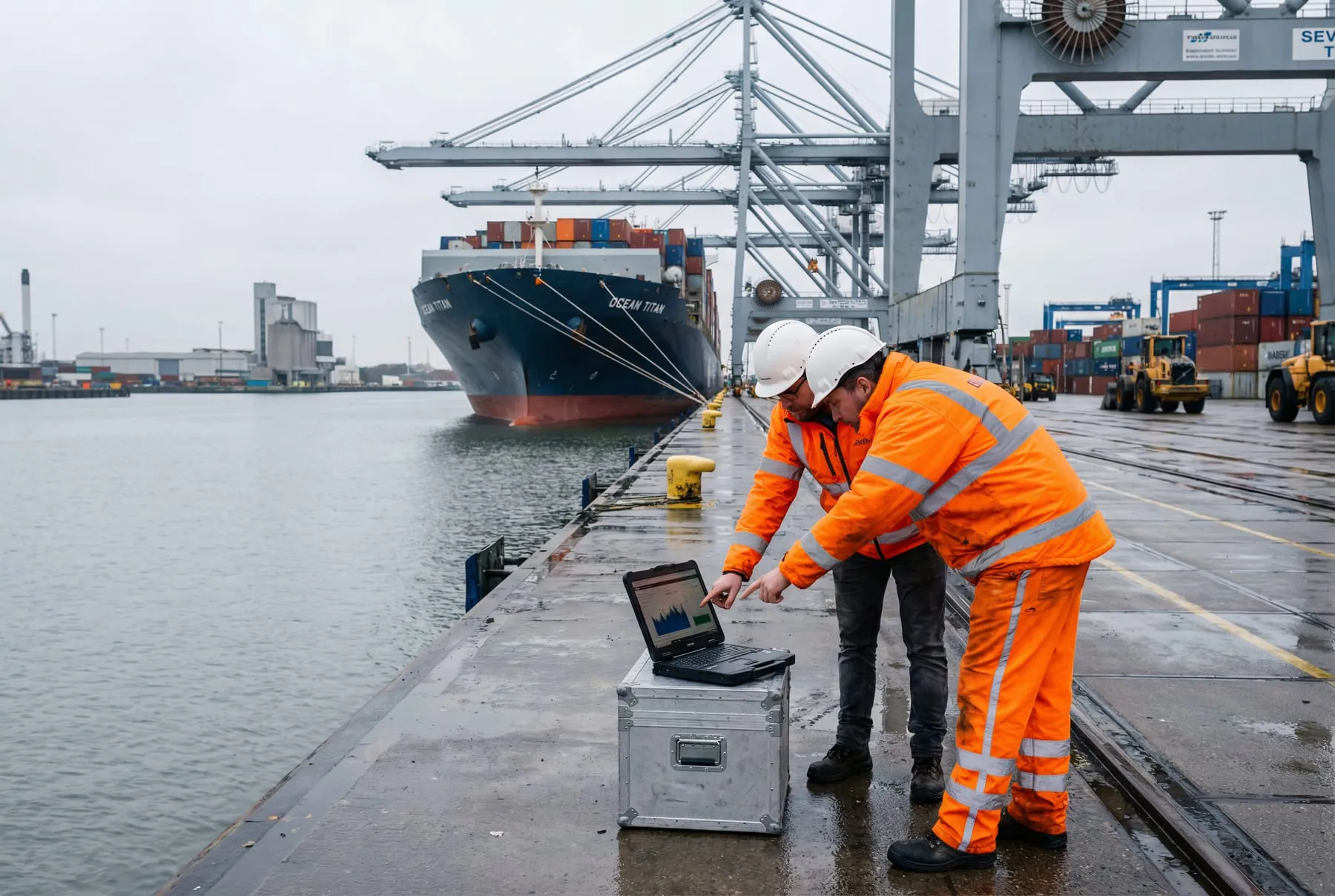
Generic hero imagery. A wide shot of a container ship at sunset is the maritime equivalent of a stock photo of people pointing at a laptop. It signals nothing. Worse, it signals that you couldn’t be bothered to commission your own photography of your actual vessels, terminal or yard. Specificity is credibility.
Vague headlines. “Delivering excellence in maritime services.” “Your trusted partner at sea.” “Connecting global trade.” None of these tell a fleet director whether you do technical management, commercial management, crewing, port agency or marine insurance. If your headline could be on a competitor’s site without modification, it’s wrong.
No proof above the fold. A serious maritime website surfaces credibility signals in the first viewport: vessel count, fleet age, ports served, classification societies, MLC compliance status, accreditation logos, named clients (where charter parties permit). Most homepages bury this on an “About” page nobody reaches.
Slow load times. A homepage that takes seven seconds to render on a 4G connection has already failed the test before content arrives. We see this constantly: 4MB hero videos, render-blocking fonts, twelve marketing scripts loaded synchronously. The buyer has clicked away by the time your headline appears.
What a passing homepage looks like
Three things a buyer should know in four seconds:
-
What you are. Specific. “Independent technical ship manager, 80 vessels under management, headquartered in Limassol with offices in Singapore and Hamburg.” Not “global maritime solutions provider”.
-
Who you serve. Tankers, dry bulk, container, offshore, specialised? Greek-owned, Japanese-owned, listed shipping companies? Be explicit about who you’re for; you’ll repel non-fits and attract fits.
-
Proof you’re real. A vessel photo from your actual fleet (not a stock library). A class society logo. A named partner or client. A statistic with a number, not a superlative.
That’s the floor. Most maritime homepages don’t clear it.
A test you can run today
Open your homepage in an incognito window. Cover the top half with your hand. Now ask: from what’s visible in the bottom half, can you tell anything about the business? Now uncover the top half and time how long it takes to load. If the answer to the first question is no, or the load time is over four seconds, your homepage is losing buyers you don’t even know about.
The fix isn’t a redesign for its own sake. It’s a homepage that respects how little time the buyer is giving you.
Frequently asked questions
Is four seconds a real number or marketing nonsense?
What's the single most common four-second failure?
Does a video hero help or hurt the four-second test?
More on Web Design
-

Web Design
Designing maritime case study pages that actually convert
Most maritime case studies are capability decks dressed as case studies. Here's how to design pages that move buyers from interest to enquiry.
 By Paul Clapp
 -
Web Design
Content modelling for marine equipment product catalogues
Marine equipment catalogues fail when treated as marketing pages. Modelling them as structured product data unlocks search, comparison and integration.
By Paul Clapp -

Web Design
How to brief a maritime web design agency and not waste six months
A vague brief produces a generic site. Here's how to brief a maritime web design agency so you get a build that's commercially useful and on time.
By Paul Clapp