
Trust signals every maritime website should display above the fold
Maritime buyers shortlist on credibility. The signals you put above the fold do most of the qualifying work before they ever read a word of body copy.

A fleet director shortlisting suppliers gives your homepage four to six seconds before deciding whether to read further. In that window, the trust signals you display above the fold do almost all the work. Get them right and the rest of your site has a chance. Get them wrong and your beautifully written service pages will never be seen.
Trust in maritime is conservative. The sector has long memories, narrow networks and high consequences for choosing wrong. Buyers are looking for evidence that you’re real, established, accountable and credible to peers. Marketing language doesn’t deliver that. Specific signals do.
The signals that matter
Classification society and flag-state evidence
For ship managers, owners and operators, the classification societies you work with (DNV, Lloyd’s Register, ABS, BV, ClassNK, RINA) and the flag administrations under which your vessels trade are first-order credibility signals. Display them. A row of class society logos near the homepage hero communicates more about your operation than 200 words of about-us copy.
For equipment manufacturers, class type-approval marks (DNV, BV, ABS), the EU Marine Equipment Directive (MED) wheelmark and relevant IMO-derived compliance statements (MARPOL Annex VI, NOx Tier III) do the same job. A SOLAS-equipment manufacturer who doesn’t surface their MED wheelmark above the fold is hiding their main credibility asset.
Real client and partner names (where permitted)
Charter parties, consultancy NDAs and procurement contracts often restrict naming. Where you can name, name. Where you can’t, describe specifically.
A row of recognisable owners, charterers, ports or principals carries weight. So do listed-company logos, defence-related work, named major projects, port concessions. The more specific the recognition, the stronger the signal.
Vessel count, fleet age, ports served
Quantitative anchors above the fold tell a buyer the size and scope of your operation immediately. “84 vessels under management, average age 7.2 years, served from offices in Limassol, Singapore and Hamburg” tells a buyer more in one line than a homepage of marketing copy.
Use real numbers. “Hundreds of clients” reads as evasion. “127 client owners across 19 flag states” reads as confidence.
Accreditations and memberships
ISM, ISO 9001, ISO 14001, ISO 45001, MLC compliance, BIMCO membership, Intertanko, Intercargo, ICS, RightShip rating, SIRE 2.0 readiness, Vetting status. Use the ones genuinely relevant to your audience. Don’t pad with logos that don’t apply (an ISO 27001 certificate is great, but it’s not what a chartering manager is looking for).
Compliance posture for current regulation
A 2025 maritime website that doesn’t visibly engage with EEXI, CII, FuelEU Maritime, EU ETS and ballast water compliance reads as outdated. A short statement of compliance approach, ideally with a link to a substantive briefing, does double duty as both trust signal and SEO asset.
Genuine credentials of named people
A short row of “key people” with full names, real photos, role and a LinkedIn link is a strong signal in maritime. The sector trades on personal trust. Stock photos of generic professionals destroy credibility instantly.
Where most maritime sites get it wrong
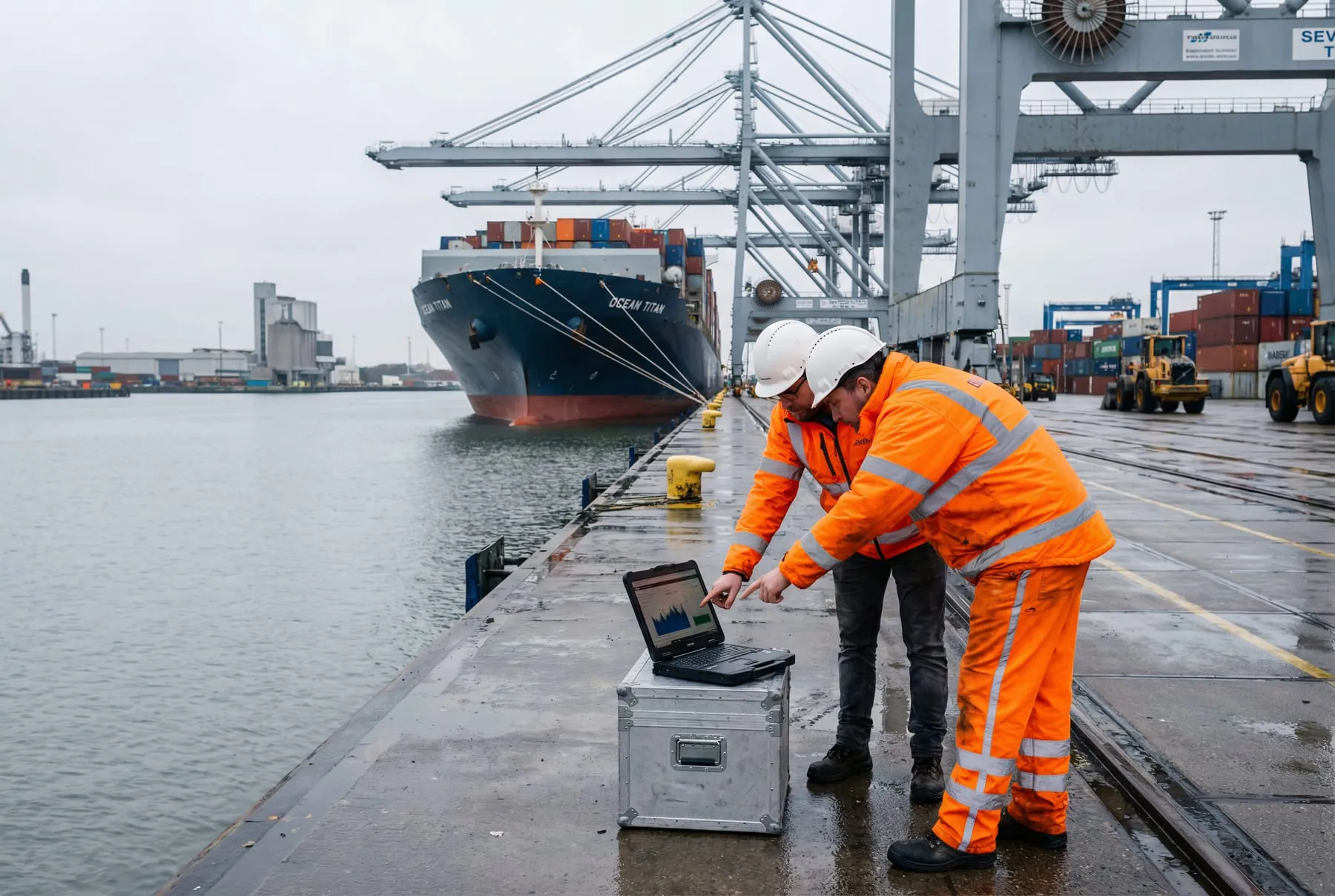
Stock photography. A hero of a generic container ship at sunset signals nothing about your real operation. Photos of your actual fleet, terminal or yard always beat library imagery, even if technically less polished.
Empty platitudes. “Trusted globally”. “Partners of choice”. “Industry leaders”. These are anti-signals. Buyers have read them on every competitor site. Replace with specifics.
Logo walls of vendors. Eight of your software vendors and your bank’s logo on a “trusted by” wall confuses the buyer about what you actually do. Logo walls should be clients and operating partners, not your tech stack.
Awards from 2017. A “best maritime website” badge from an awards programme that’s now defunct is worse than no badge. Either refresh or remove.
A simple test
Take a screenshot of your homepage above the fold, no scrolling. Send it to three buyers in your target segment with the question: “What does this company do, who does it serve and would you take a 30-minute call with them?” If two of three can’t answer all three questions affirmatively, your trust signals aren’t earning their position.
The above-the-fold real estate on a maritime site is your most valuable square inch. Make every element earn its space.
Frequently asked questions
Aren't logo walls a bit cheesy?
What if our charter parties don't allow client names?
Should we display certifications and class society logos prominently?
More on Web Design
-

Web Design
Designing maritime case study pages that actually convert
Most maritime case studies are capability decks dressed as case studies. Here's how to design pages that move buyers from interest to enquiry.
 By Paul Clapp
 -
Web Design
Content modelling for marine equipment product catalogues
Marine equipment catalogues fail when treated as marketing pages. Modelling them as structured product data unlocks search, comparison and integration.
By Paul Clapp -

Web Design
How to brief a maritime web design agency and not waste six months
A vague brief produces a generic site. Here's how to brief a maritime web design agency so you get a build that's commercially useful and on time.
By Paul Clapp